
Learning Feminism Before Knowing Its Name: Verse’s Story
- kay88857
- Nov 26, 2025
- 3 min read
Updated: Dec 2, 2025
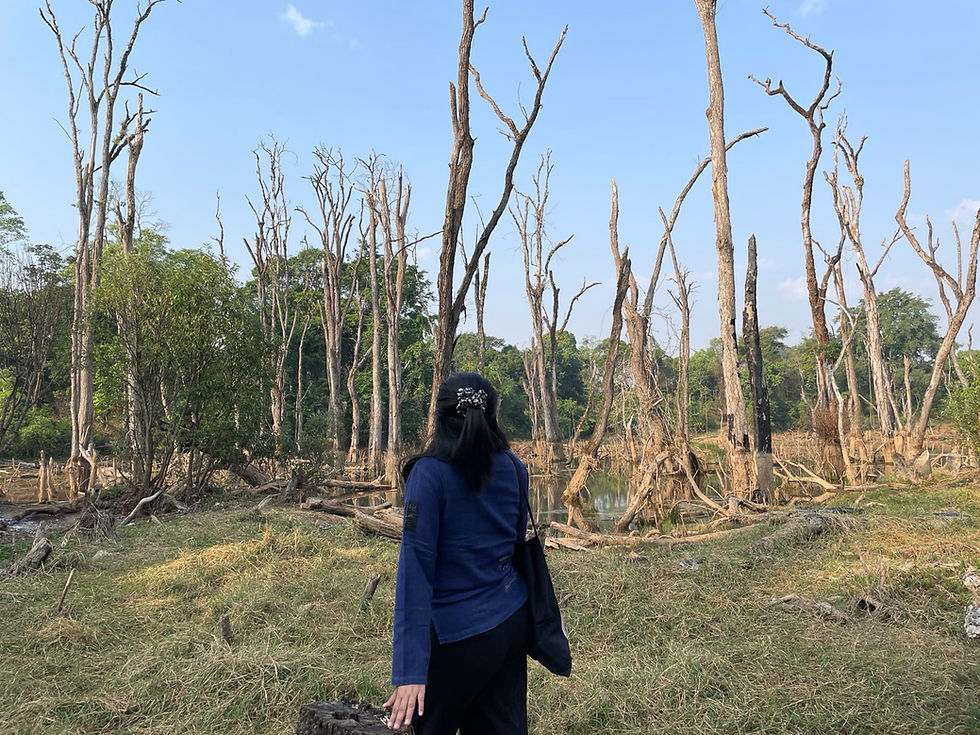
As a filmmaker shaped by her grandmother’s quiet defiance, Verse uses storytelling to challenge gender bias and uplift women whose voices are too often erased.
Verse began her professional journey in 2018 as a reporter at a local news agency. She dreamed of covering political news, but quickly was met with systemic gender bias. During a major assignment, male reporters were sent to Nay Pyi Taw to cover parliament-related matters and she was told to stay behind.
She recalled the moment:
“I was told women weren’t given those opportunities. I could not accept a workplace that denied my growth simply because I was a woman.”
She left journalism and joined a women’s rights organization, shifting her focus to human rights and feminist advocacy.
Before Verse ever stepped into a newsroom or picked up a camera, she grew up watching a woman who quietly defied the rules of her time, her grandmother. A tough, respected Rakhine woman running a sawmill business, working daily among men, and refusing to bend to the gender norms imposed on her.
Verse talks about her grandma proudly:
“She never once told me, ‘you’re a girl, so you can’t do this.’ She taught me that actions have consequences, but gender should never be a limitation.”
Her grandmother’s philosophy became the backbone of Verse’s feminist worldview. Even in small everyday acts, her grandmother pushed against societal expectations. While the neighborhood insisted women must hide their underwear under the longyi when drying laundry, her grandmother thought differently. From a health perspective, she said underwear needed sunlight to prevent bacteria. So she just hung them in front of the house. She never believed being a woman meant you had less dignity.
Growing up under such influence, Verse absorbed feminism not through books, but with lived experience through a woman who modeled resilience, pride, and equality long before Verse learned the word “feminist.”
In 2020, Verse attended Yangon Film School, where she began translating feminist ideas into visual storytelling. The classroom itself became another frontline of gender bias. Six male and six female students attended. One day, a male classmate asked her an inappropriate question rooted in a harmful cultural myth about girls with arm hair or slight mustaches being “sexually provocative.”
She was hurt and angry but she chose a different response.
During a group discussion in class, Verse brought the incident forward, sparking an honest conversation about how students should respond when they encounter verbal harassment. Her courage led the film school to introduce its first-ever zero-tolerance policy on sexual harassment.
Verse’s filmmaking has since become an extension of her feminist inheritance. Her storytelling centers women who are often unheard or unseen.
“Through film, I want people to feel empathy to see women’s emotions, existence, and oppression in new ways. My mind is always thinking for them”
One of her most meaningful works is the animated film “Exit,” portraying the lived experiences of sex workers in Myanmar women facing stigma, violence, and criminalization. Supported by Goethe-Institut Myanmar, the film has been screened at the Shi Exhibition and DVB Peacock Film Festival 2024.

Verse first learned about Exile Hub in 2022 through a Critical Voices production grant received. In 2025, she was again selected as a recipient of the Feminist Storytelling Grant, under which she created the documentary “Fight for Freedom.”
The film follows an exiled woman resisting Myanmar military patriarchy, a story of courage,and the fierce determination to spark ideological revolution. There is no hierarchy of oppression whereby one form is not greater or lesser than another. Every form of oppression must be challenged and dismantled.
Though her professional opportunities have widened, Verse still makes her home in Myanmar. Her grandmother is aging and requires care.
She says simply: “She didn’t just raise me. She taught me my worth. She made sure I never believed my gender was a limitation. How could I ever leave her behind?”
Feminism, for her, is a lived experience grounded in resilience and the courage to challenge oppression wherever it appears.Through her films, Verse continues her belief by reshaping narratives, breaking barriers, and imagining a world where women’s voices are not just heard, but honored.
Verse’s life is shaped by a simple ideology
“Women deserve equality, dignity, and the freedom to define their own lives.”


Comments