
Myat Moe Thu, a Woman Journalist in Myanmar’s Conflict Zones
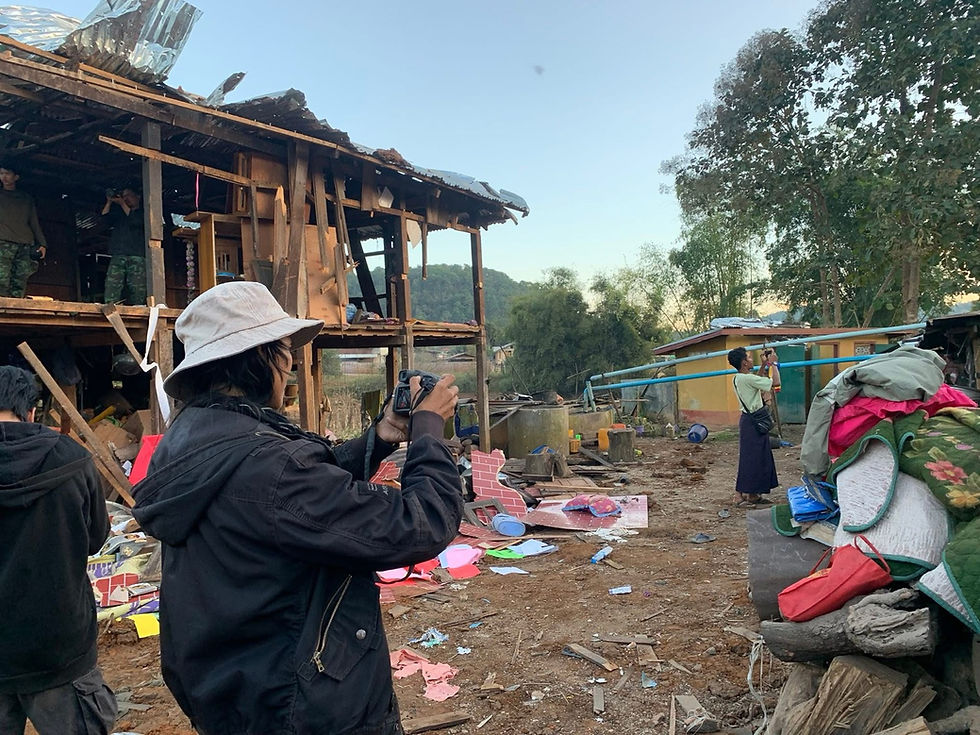
What you see in the frame is a woman holding a camera in a war zone.
What you don’t see is everything beyond it, the sound of aircraft overhead, the fear of a second strike, and people running for safety.
While others fled, Myat Moe Thu, a recipient of Exile Hub’s Critical Voices Fellowship 2026, moved toward the scene.
A journalist reporting from the border areas between Shan and Kayah (Karenni) States, she documents the realities of war as they unfold. On the day this image was taken, a military jet had just dropped two 500-pound bombs on a civilian village. As residents fled, fearing another attack, she walked into the aftermath to gather the story.
There was no protective gear. No guarantee of safety. Only a decision to bear witness.
Myat Moe Thu did not begin her career in journalism. She was working in marketing when during a visit to a media outlet, she was asked if she had ever considered becoming a journalist.
She didn’t fully know what the work would demand, but she chose to try, and eventually fell in love with telling stories and sharing information through her writing.
Even before the coup, she began covering armed conflict, gradually building an understanding of the complexities, risks, and political realities on the ground. Since the coup, she has never left Myanmar. Instead, she has moved between areas often referred to as “liberated territories” in ethnic states, continuing her work as a freelance journalist from within conflict zones.
For Myat Moe Thu, journalism is not only about documenting events. It is about responsibility and ethics.
“If we don’t report what is happening, the truth disappears. Reporting doesn’t mean taking sides. It means being accurate, respecting the dignity of those affected, and ensuring that the voices of civilians are not distorted or exploited no matter which side they are on. I know not everyone will agree with me on this.”
Working in conflict zones requires more than courage. It demands careful judgment: what to report, how to protect sources, and how to ensure that stories do not cause further harm to already vulnerable communities.
Being a woman journalist in war zones brings additional challenges.
Cultural expectations often frame field reporting as work more suited for men. Women are frequently underestimated or discouraged from entering dangerous environments. At the same time, practical realities such as traveling long distances and sharing limited space with male colleagues can require personal compromises that are rarely acknowledged.
Despite these barriers, she continues her work quietly challenging both societal expectations and structural limitations.
Beyond physical danger, journalists in Myanmar often face misunderstanding even from their own communities. Some people cannot distinguish between journalists and informants or intelligence agents. Others see journalists as intrusive people who ask too many questions. There is even a saying that suggests covering one’s meal to avoid journalists “finding out too much.”
For Myat Moe Thu, this misunderstanding extends to her personal life. Even family members and relatives struggle to fully grasp the purpose and urgency of her work.
Journalism, she reflects, comes with a cost, distance, isolation, and, at times, rejection.
“I sometimes think even someone who has done something wrong might get a second chance. But for journalists, if people lose trust in you, there is no turning back.”
Beyond the visible risks lies a quieter struggle: mental and emotional exhaustion.
Prolonged exposure to conflict, instability, and trauma creates conditions for burnout. For journalists working in exile, access to support is already limited. For those reporting from inside conflict zones, it is even more out of reach.
There is often no time, space, or resources to seek help. And yet, she continues.
What keeps her going is not the absence of fear but the absence of regret.
She shares, “I know I will not regret choosing what I believe is right.”
For journalists like Myat Moe Thu, the line between professional duty and personal survival is never fixed. It shifts with every assignment, every decision, every risk taken.
And still, she keeps reporting. Because in places where silence is enforced, the act of telling the truth is not just journalism. It is resistance.


Comments